
 by
by The Business-Cycle Index is produced by the Federal Reserve Bank of Dallas and “measures broad movements in local economic conditions. The indexes are constructed based on the aggregated movements in the local area unemployment rate, nonagricultural employment, inflation-adjusted wages and inflation-adjusted retail sales taxes.”1 While gross domestic product (GDP) is the most commonly used measure of movements in the national macroeconomy, there is a lag in the GDP figures produced for the states and metropolitan areas. The Business-Cycle Index fills this void by providing a more recent measure of the movements of the macroeconomy at the state and metropolitan area levels.
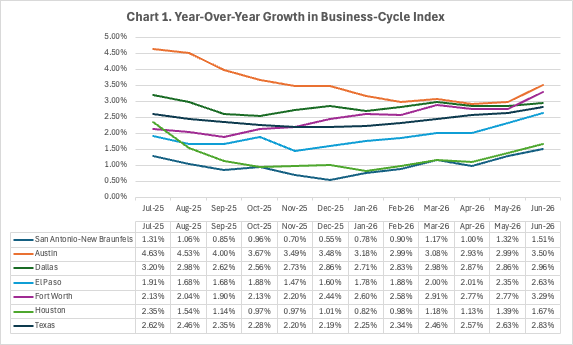
As shown in Chart 1, growth has accelerated since the end of last year for the state and in all of the major metropolitan areas. However, the Houston and San Antonio-New Braunfels metropolitan economies saw their growth slow much more in the first six months of this time period, and while their growth rates have been accelerating in the last six months through June, they are lagging the growth in the other metropolitan areas by a sizeable margin. For instance, year-over-year growth in the San Antonio-New Braunfels and Houston economies was 1.51% and 1.67%, respectively in June. This is compared to 3.50% growth in Austin and 3.29% growth in Fort Worth with the state economy growing 2.83%.
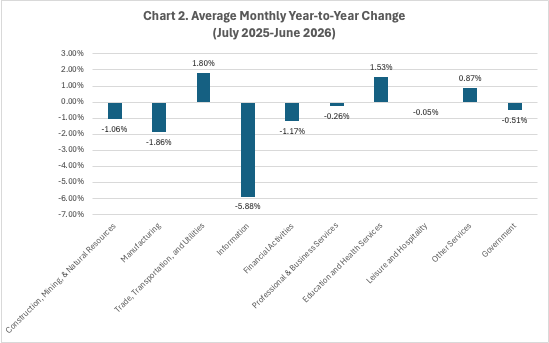
Since the San Antonio-New Braunfels economy had the slowest growth, I took a look at what has been happening to employment growth by industry in this area. I calculated the year-over-year growth in employment for each month from July 2025 through June 2026 and averaged the growth rates. Chart 2 shows these growth rates. The slow growth rate in San Antonio-New Braunfels is broad-based, as seven of the ten industries had negative average growth rates. Only the trade, transportation, and utilities; education and health services; and other services industries had positive growth. The largest decline was in the information industry followed by manufacturing, and financial activities. It is also worth keeping in mind that these average figures do not indicate changes in growth in any of the months over this time period. For instance, professional and business services had an average growth of -0.26% over the twelve month period, but this masks that in the first eight months employment growth was negative in each month, while in the last four months, the industry had positive employment growth each month, so it seems to have turned the corner to growth.
- Federal Reserve Bank of Dallas. Business-Cycle Indexes. https://www.dallasfed.org/research/econdata/mbci ↩︎
Steve


Leave a Reply