
 by
by Employment in the U.S. declined by 23,000 jobs in July.1 As shown in the following chart, this continues a pattern of slowing growth since April of this year, and rather anemic growth from month-to-month over the past months. However, the unemployment rate declined from 4.2% in June to 4.1% July, which on the face of it seems odd given the decline in employment. The decline in the unemployment rate is due to the fact that 381,000 people dropped out of the labor force, so they are not counted as unemployed. This is another indication of weakness in the labor market and has been happening for several months.2 The weak labor market coincides with relatively weak growth in gross domestic product.3
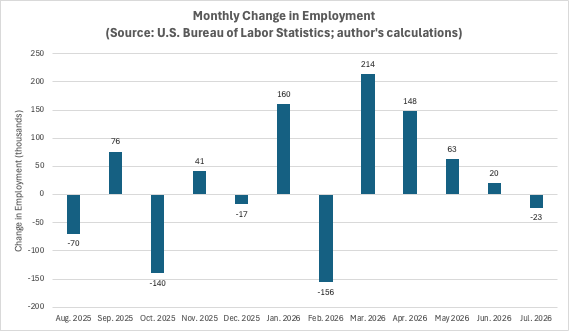
Growth in the U.S. economy has been rather weak, but inflation continues to be high at 3.5% as of June.4 Stagnant growth with relatively high inflation indicates to me that the U.S. economy is in a stagflation, albeit a somewhat mild one, and has been for some time.
- U.S. Bureau of Labor Statistics. August 7, 2026. Employment Situation Report. p. 1. https://www.bls.gov/news.release/pdf/empsit.pdf ↩︎
- U.S. Bureau of Labor Statistics. August 7, 2026. Employment Situation Report. Table A-1. https://www.bls.gov/news.release/pdf/empsit.pdf ↩︎
- U.S. Bureau of Economic Analysis. July 30, 2026. GDP Advance Estimate, 2nd Quarter 2026. https://www.bea.gov/news/2026/gdp-advance-estimate-2nd-quarter-2026 ↩︎
- U.S. Bureau of Labor Statistics. July 14, 2026. Consumer Price Index – June 2026. https://www.bls.gov/news.release/pdf/cpi.pdf ↩︎
Steve


Leave a Reply