Page 5 of 5

Creative Industries, Creative Class, and the Effects on Urban Economic Growth

I recently read an article by Erik Stam, Jeroen P.J. de Jong, and Gerard Marlet called “Creative Industries in the Netherlands: Structure, Development, Innovativeness and Effects of Urban Growth.” Part of their research documented in this article looks at the effects of the creative industries and the creative class on innovation and urban economic growth. The difference between the two is that the creative industries is defined by industry sectors (e.g., NAICS codes), and the creative class is defined by occupations. I think the conclusions they draw from their research is quite interesting and very useful for economic development policy.

The analyses show that, with the exception of the metropolitan city of Amsterdam, there is no relation of the presence of creative industries with employment growth. In general, it seems that a concentration of creative industries is a less important determinant for employment growth in cities than a concentration of creative people/creative class. Creative industries do not seem to act as a catalyst for the effect of knowledge (spillovers) on urban economic growth in general. This seems to occur only in the metropolitan city of Amsterdam. This role is ore likely to be taken by the creative class, which was shown to have a much stronger relation with employment growth than the creative industries. If the objective of local economic policy is employment growth, improving living conditions for the creative class…could be more effective than creating conditions for stimulating the creative industries, which is currently widespread policy in the Netherlands…If the objective is not specifically employment growth, but is more focused on the innovativeness of the business population, creating conditions to stimulate the creative industries seems a reasonable policy, as we have shown that firms in the creative industries are more innovative than firms in other industries. However, our study shows that the creative industries are very heterogeneous; businesses in the distinctive domains face different constraints. One policy to stimulate all the creative industries will be less effective than more specific policies tailored to the nature of the specific domains.

Our findings call for a focus on living conditions and labour markets…attracting and retaining individuals in the creative class, instead of business conditions for attracting firms belonging to the creative industries if growth in cities is the objective. Only in very specific urban environments, such as the metropolitan city of Amsterdam, does a policy to attract and stimulate business activities in the creative industries seem to be justified. Perhaps metropolitan environments distinguish themselves from other lower order cities by their intensive social and cultural activity (including creative industries) that provides a source of inspiration for other economic activities…, the local ‘buzz’ of unpredictable, innovative interactions…(pp. 128-129).

I agree with their conclusion that economic development is more about attracting people than attracting companies, but there has to be a place for the creative class to work, so it is also important that the appropriate conditions exist within a metropolitan economy to stimulate the creation, growth, and attraction of creative industry businesses as well. In other words, it is important, as it always has been, that innovation be catalyzed for an urban economy to develop, which brings us back to their point about the importance of creative industries in fostering innovation.

(The article cited in this post was published in the journal Geografiska Annaler: Series B, Human Geography in 2008.)

SN logo no name

Complexity Theory is the New “Great Flare” in Economics

I just finished reading Complexity and the Economy by W. Brian Arthur, and like almost all of his work, it was very enlightening. His publications are also a joy to read because his writing is on par with some of the best novelists I have read, in my humble opinion. Many thoughts and passages caught my attention throughout the book, but I found the following paragraph particularly novel-like and thought-provoking.

“Economics as a discipline is often criticized because, unlike the ‘hard sciences’ of physics or chemistry, it cannot be pinned down to an unchanging set of descriptions over time. But this is not a failing, it is proper and natural. The economy is not a simple system; it is an evolving, complex one, and the structures it forms change constantly over time. I sometimes think of the economy as a World War I battlefield at night. It is dark, and not much can be seen over the parapets. From a half mile or so away, across an enemy territory, rumblings are heard and a sense develops that emplacements are shifting and troops are being redeployed. But the best guesses of the new configuration are extrapolations of the old. Then someone puts up a flare and it illuminates a whole pattern of emplacements and disposals and troops and trenches in the observers’ minds, and all goes dark again. So it is with the economy. The great flares in economics are those of theorists like Smith or Ricardo or Marx or Keynes. Or indeed Schumpeter himself. They light for a time, but the rumblings and redeployments continue in the dark. We can indeed observe the economy, but our language for it, our labels for it, and our understanding of it are all frozen by the great flares that have lit up the scene, and in particular by the last great set of flares” (p. 143).

In my opinion, complexity theory or complexity economics is the next “great flare” in economics, and when (if) it becomes mainstream economics, my hope is that it will naturally take us past the machine-like view of the economy into a deeper, more appropriate view of the economy as a continually evolving complex system. This will also hopefully move us beyond the religious zeal to which we tend to adhere to the “great flares” that can be cataclysmic in the worst of its applications into a more open-minded understanding of economics and its application to public policy and our everyday lives.

I also love the fact that he mentions folks like Ricardo, Marx, and Schumpeter as one of the theorists who launched some of these “great flares.” In mainstream macroeconomics, these three economists get very little, if any, mention in the textbooks. IN fact, I looked in some of my macroeconomics textbooks last semester, and in some they were not mentioned at all. In fact, I could not find one that mentioned Marx. If Ricardo and Schumpeter were mentioned, they received a paragraph worth of text, at best. Even more surprising to me was that the history of economic thought books I have do not give Marx and Schumpeter full chapters. I agree with Arthur that these men forth theories that were “great flares,” and as such, they should be part of required economic education.

Development Around the Tobin Center: A Photographic Study

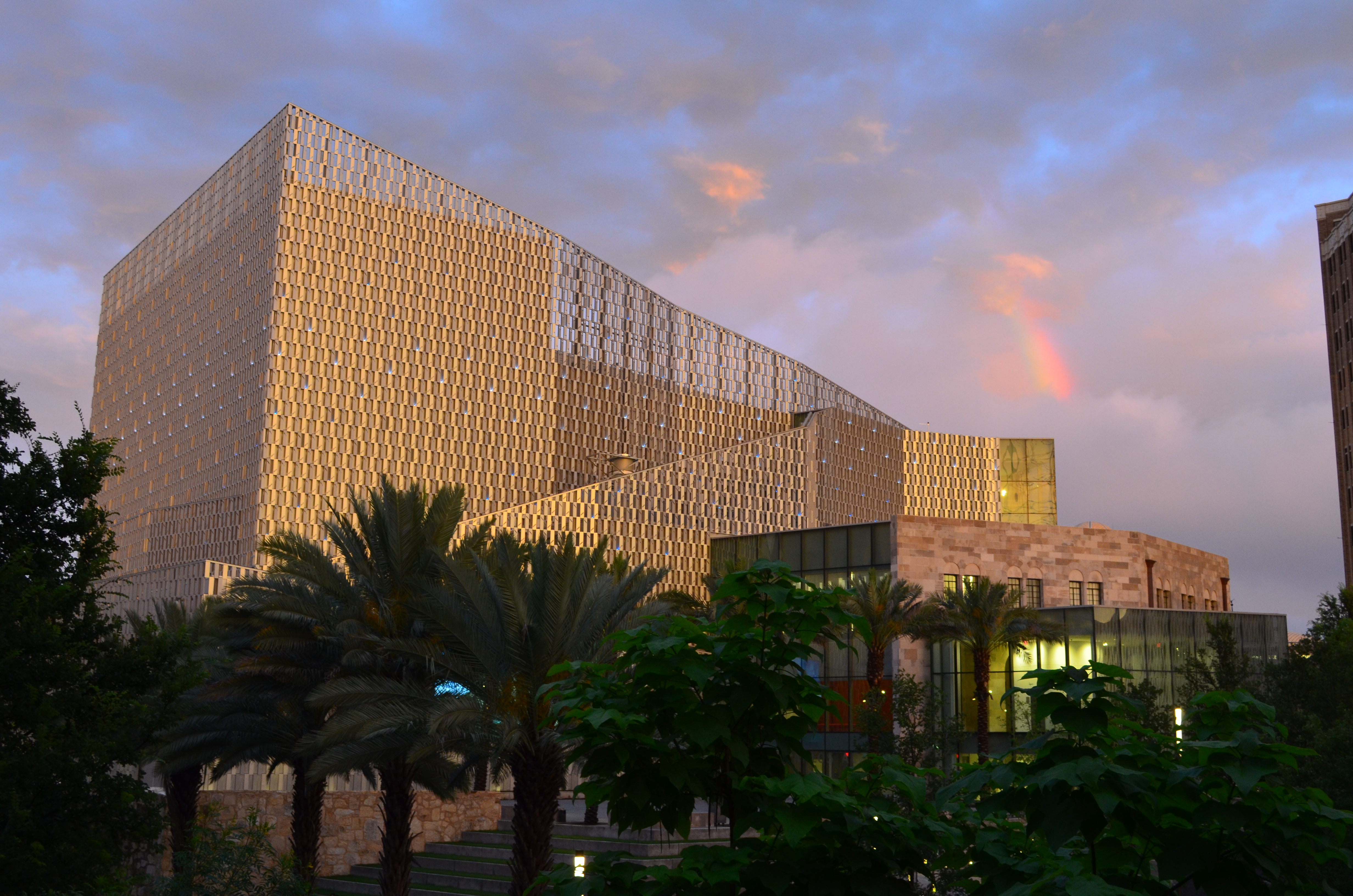
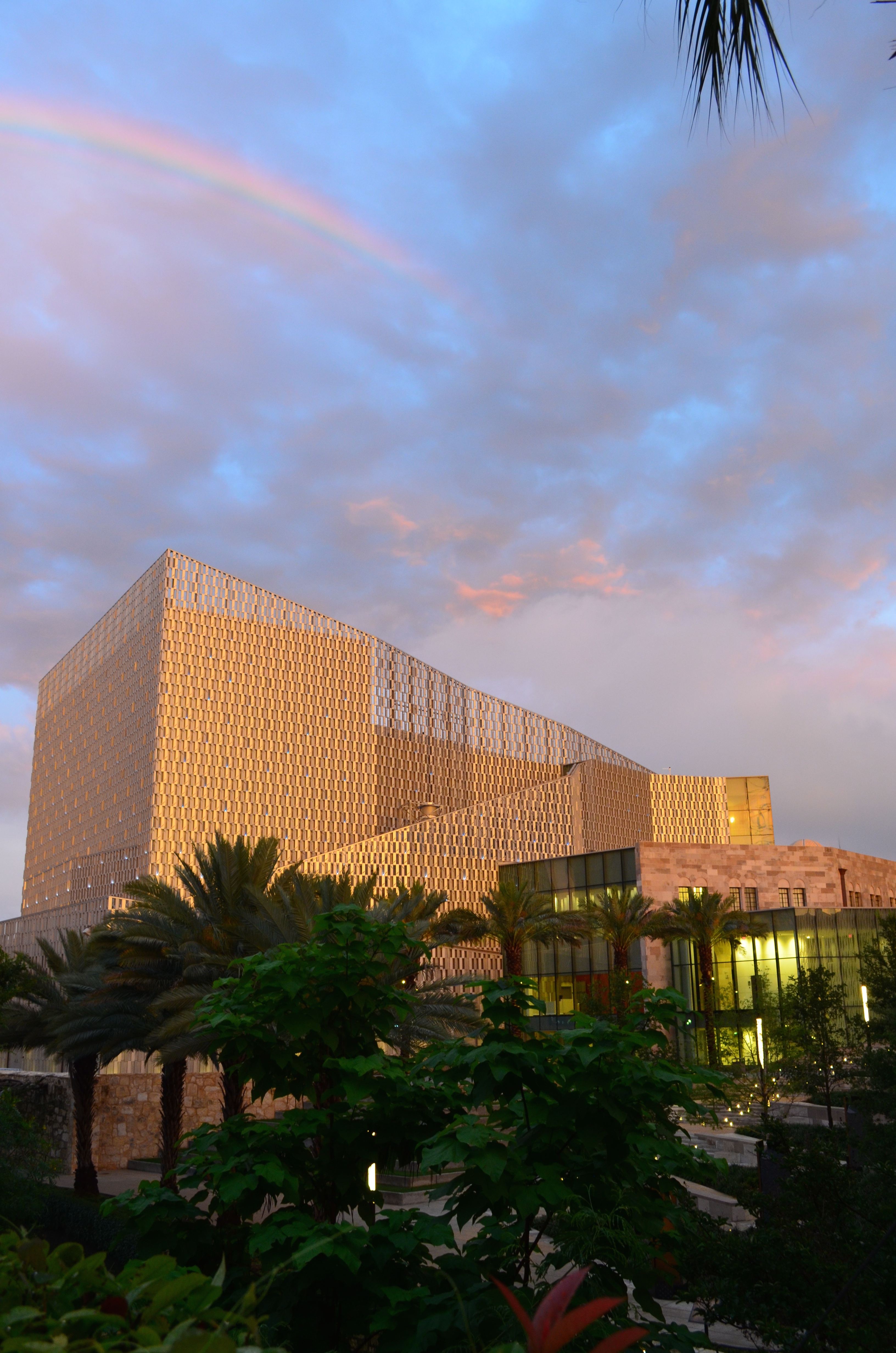
Last weekend, my family and I had the pleasure of staying at the Hotel Indigo – a very nice hotel and great value. The hotel sits right across the River Walk from the Tobin Center for the Performing Arts, and while we were at the pool, a rainbow appeared above the hotel and the Tobin Center. I immediately ran and grabbed our camera to see if I could get some good shots before it disappeared. In fact, a bunch of people staying at the hotel very quickly gathered on the patio by the pool to take pictures. The header photo to this blog is one of the photos I was able to capture. The full picture of the header photo along with a few others I captured are shown at the bottom of this post. You can also see some pictures and read about my wife’s perspective on the events at her blog: http://www.livinsassy.com.

I have done several economic analyses of the impacts of various new facilities, redevelopments, and transportation projects. It is a lot of fun to do these studies, as I love crunching the numbers, but as the Tobin Center was being built, I came up with the idea of studying the impacts it would have on development in the immediate area. I have done quite a bit of cultural planning and analysis of the interplay between the arts and economic development, but I have never had the opportunity to follow the impact of a facility like this on economic development over time. The difference with this analysis is that I would track the development over the years photographically. I can complement the photographs with the numbers later, but I think it will be great fun to use the camera as a tool in the analysis. I will be able to pursue two of my passions – photography and economics – all in one project. As previously mentioned, this idea came to me while the Tobin Center was being built, so obviously, I have been procrastinating in getting this project started. The beauty of the rainbow, the Tobin Center, the Hotel Indigo, and being with my family and my daughter’s great friends this past weekend provided me the inspiration and motivation to finally get to work on it. So, the project has officially begun. I will post more soon about how you can follow it. This is a long-term project, as the development will not occur overnight, so if you do plan to follow the project, please be patient. I am confident the development will occur, and as it does and as I am able to capture it with my camera, I will post the pictures and my thoughts. It will be fun!

DSC_0443

DSC_0436

DSC_0446

DSC_0442

Mexican Nationals Spending in El Paso

I recently spoke at the International Conference of Shopping Centers West Texas Idea Exchange conference. Here is the presentation: Presentation on Mexican Nationals Impact to ICSC 4-22-15. Of the twenty counties included in this study, El Paso received the highest amount of spending by Mexican Nationals in 2012 at almost $446 million. Our estimate is that the largest amount of money is spent on clothing at about $205 million.

On a side note, I was very impressed with the accomplishments El Paso has made in its economic development and its approach for future development. This includes an awesome new baseball park in their downtown and renovations to a new theater and improvements/additions to other arts facilities in their center city. They also have much more to come with some exciting mixed use projects downtown and in other parts of the city, as well as a streetcar serving the downtown area that will be installed in the neat future. I know the recent economic numbers don’t necessarily show it, but from my quick “on the street” view of the city, they are moving in the right direction.