Page 3 of 5

Insights #2: Innovation is a Collective Process.

I am currently reading The Value of Everything by Mariana Mazzucato, and one of the great insights she provides in the book is the key role that the public sector plays in innovation. It busts the stereotype of innovation being driven by the lone inventor toiling away in his or her garage or dorm room. I believe she has written a book on this very topic, which I have not read, yet, but it is high on the reading list. I think the following passages summarize this insight pretty well.

Understanding both the role of the public sector in providing strategic finance, and the contribution of employees inside companies, means understanding that innovation is collective: the interactions between different people in different roles and sectors (private, public, third sectors) are a critical part of the process. Those who might otherwise be seen as lone entrepreneurs in fact benefit from such collectivity; moreover, they stand on the shoulders of both previous entrepreneurs and taxpayers who, as we will see, often contribute to the underlying infrastructure and technologies on which innovation builds (p.194).

Examples she provides include:

  • The smartphones many of us depend on these days are driven by technologies created with public funding.
    • The internet and SIRI were developed with funding from the U.S. Department of Defense.
    • Touchscreen display was developed with funding from the CIA.
    • GPS was developed with funding from the U.S. Navy.
  • The U.S. National Institutes of Health has funded the research supporting the development of two-thirds of the most innovative pharmaceuticals.
  • U.S. Department of Energy has funded many of the greatest breakthroughs in energy (p. 194).

As she then goes on to point out, “In the very early days it is often public R&D agencies or universities that fund the science base, and only when innovation is close to having a commercial application do private actors enter” (p. 195).


Source:

Mazzucato, M. (2018). The Value of Everything. New York, NY: PublicAffairs.

Insights 1: Econs and Humans

I am launching a new series – called “Insights” – that will include posts on brief statements of wisdom or viewpoints that I come across in my readings or other sources. My hope is that this will pique your curiosity and encourage further exploration of the topic.

The first insight comes from Dr. Daniel Kahneman. I just finished reading his book, Thinking, Fast and Slow, which is full of great insights, especially if you have an interested in human behavior and economics. If you have not read it, I highly recommend it.

In this passage from the book, an “Econ” is the name given to the fictitious person modeled in neoclassical economics.

In a nation of Econs, government should keep out of the way, allowing the Econs to act as they choose, so long as they do not harm others. If a motorcycle rider chooses to ride without a helmet, a libertarian will support his right to do so. Citizens know what they are doing, even when they choose not to save for their old age, or when they expose themselves to addictive substances. There is sometimes a hard edge to this position: elderly people who did not save for retirement get little more sympathy than someone who complains about the bill after consuming a large meal at a restaurant. Much is therefore at stake in the debate between the Chicago school and the behavioral economists, who reject the extreme form of the rational-agent model. Freedom is not a contested value; all the participants in the debate are in favor of it. But life is more complex for behavioral economists than for true believers in human rationality. No behavioral economists favors a state that will force its citizens to eat a balanced diet and to watch only television shows that are good for the soul. For behavioral economists, however, freedom has a cost, which is borne by individuals who make bad choices, and by a society that feels obligated to help them. The decision of whether or not to protect individuals against their mistakes therefore presents a dilemma for behavioral economists. The economists of the Chicago school do not face that problem, because rational agents do not make mistakes. For adherents of this school, freedom is free of charge (p. 412).

Source:

Kahneman, D. (2011). Thinking, Fast and Slow. New York, NY: Farrar, Straus, and Giroux.

Unemployment Rate in San Antonio at Its Floor

The unemployment rate in San Antonio in July was at a seasonally adjusted rate of 3.2%. Since May 2017, it has been in the range of 3.1-3.5% each month. This is about as low as the unemployment rate has ever been in San Antonio since January 1990, as far back as the data goes. The lowest it ever got was in March and May 1999 when it reached 2.9% in each of those months.

As shown in the graph, for about the past year, the unemployment rate has been near the level it was during the dot come bubble leading into the recession in 2000 and about one-half to almost a full percentage point lower than the unemployment rate during the housing bubble preceding the Great Recession.

It seems to me that the San Antonio economy has been at its full-employment level of unemployment, so it is most likely the unemployment rate will only be going up over the next year or so. It may continue to hover in the aforementioned range for several months, but it appears to have hit its floor.


Unemployment SA July 2018


SRN-LogoMark-Green-FORWEB

Accounting for Non-Market Activities and Equal Pay in the San Antonio GDP

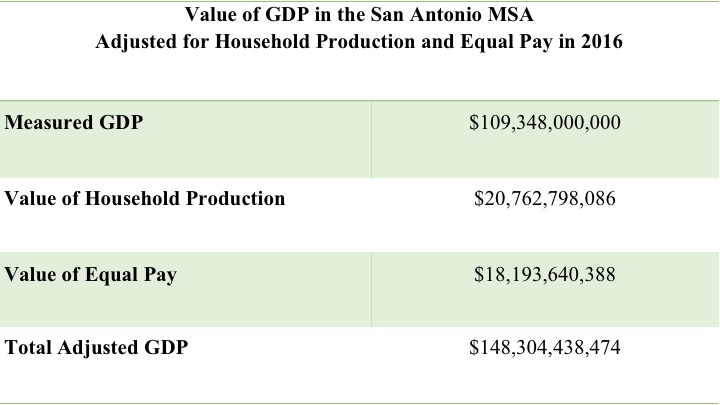
Dr. Belinda Roman and I recently completed a working paper titled, Women in the Economy. It is the first paper completed in our new research program on women in the economy. One of the many shortcomings of the gross domestic product measure is that it excludes any activity that is not conducted within a market (i.e., non-market activities). A large component of non-market activities is household production. This includes any activity it takes to run a household for which the activity is not paid, like child-care, meal preparation, yard work, and house cleaning that is done by the residents of the household. One focus of the paper was to measure the value of non-market household production in San Antonio. We also measured the addition to GDP if women received equal pay in the labor market. The following chart summarizes the results.

Slide1

As shown in the table, placing a market value on household production would add an additional $20.8 billion to GDP in San Antonio. it should be noted that household production includes the production by both men and women, but time use data indicate that women conduct the vast majority of household production. Additionally, if women received equal pay, another $18.2 billion would be added to GDP. Accounting for these two components of economic activity would raise GDP in San Antonio from $109.3 billion  to $148.3 billion in 2016.

We also recently published an op-ed article in the San Antonio Express-News that summarizes the study. The article can be found here.

Forecast of the San Antonio Economy as Presented to the GFOAT

I gave a speech today to the San Antonio chapter of the Government Finance Officers Association of Texas on the San Antonio economy. I will pull out specific charts and talk about them in detail over the next couple of weeks, but here is the entire speech for now. In short, the economy looks strong and should continue to be strong for the next year or so, but I think the probability of another recession starting within the next couple of years is pretty high.

Steve

SRN-LogoMark-Gold-HIRES


The Joy and Benefits of Writing

Most of my writing is in the form of academic papers or reports for consulting projects. I am always amazed at how hard writing actually is. It seems so easy on the face of it…just sit down and start tapping on the keyboard. It takes a remarkable amount of energy and effort, but it can bring much joy and benefits.

One huge benefit is that it makes you think. I have found that there is nothing that makes you think harder about a subject than writing about it. When I am writing about my research, the process quickly highlights any potential shortcomings in the research process or outcomes.

It can also bring great joy to the writer. Of course, if one enjoys writing, the process it self can be fun, but writing something that you think is quite good, maybe even to your surprise, can be such a high. It is a severe rush of pleasure – a “writer’s rush,” if you will.

I had this experience yesterday afternoon as I was completing a report. It was the end of the day, and I had no sleep the night before, which does not make for good writing circumstances for me. Moreover, I had come to the point of writing the conclusion section of the report. This has always been the least favorite section of any paper for me to write. This is probably due to the fact that it typically leads to long outs of writer’s block and ultimately, very uninspiring writing. As I finally dove into writing the conclusion yesterday, inspiration came out of nowhere, and when I got done writing it, I read over it and thought, “Wow, that is pretty good.”

What a rush and a great way to end the work day!

Steve


SRN-LogoMark-Green-FORWEB

Credit Cycle Starting to Worsen

I have been saying for the past few months that I think we are likely to have a recession within the next couple of years. One reason for this is that it seems the credit cycle is starting to reverse itself, especially as it relates to consumer credit.

The following four graphs pulled from the Federal Reserve Economic Database give some indication of this. As shown in Charts 1-3, delinquency rates for other consumer loans, credit card loans, and consumer loans declined pretty steadily since the economic recovery began, but since 2015, the delinquency rates have started to rise.

Furthermore, the increase in delinquencies seems to pick up pace in 2016 for all of the categories of loans with consumer loans and credit card loans maintaining the increase through 2017. Delinquencies in automobile loans have also been rising (see here).

On the positive side, delinquency rates on single-family mortgages appear to continue to decline (see Chart 4). This might just indicate that consumers are clearly financially stressed, but they are continuing to pay their mortgages on time in an attempt to at least keep their homes. If the economy does go into recession, we will see delinquency rates rise on mortgages, as well.

Consumers under financial stress are not likely to maintain their strong spending patterns, and since consumer spending is two-thirds of gross domestic product, a slowdown in consumer spending is not going to bode well for continued economic growth.

On the commercial side, the credit market seems to be fairly strong as delinquency rates are continuing to fall. It is just a matter of time, though, before this trend reverses course, too. If consumer spending starts to decline, this means goods and services will go unsold, eventually causing businesses to decrease production as inventories increase and demand for services falls. With less revenues flowing into the business, we will likely see delinquency rates start to rise. A recession cannot be far away at this point.

Chart 1. Delinquency Rate on Other Consumer Loans, All Commercial Banks (Seasonally Adjusted – gray bars indicate recessions)

Delinqunecy Rate on Other Consumer Loans All Commercial Banks

Chart 2. Delinquency Rate on Credit Card Loans, All Commercial Banks (Seasonally Adjusted – gray bars indicate recessions)

Delinquency Rate on Credit Card Loans All Commercial Banks

Chart 3. Delinquency Rate on Consumer Loans, All Commercial Banks (Seasonally Adjusted – gray bars indicate recessions)

Delinquency Rate on Consumer Loans All Commercial Banks

Chart 4. Delinquency Rate on Single-Family Residential Mortgages, All Commercial Banks (Seasonally Adjusted – gray bars indicate recessions)

Delinquency Rate on SF Mortgages All Commercial Banks

Maybe this is all just a regression to the historical mean, but I think these trends are a bit concerning and worth watching.

Steve

SRN-LogoMark-Green-FORWEB

The Imperative of Understanding the Role of Institutions, Culture, and History in Economics

I recently read an article by Dr. Avner Greif of Stanford University titled, “Cultural Beliefs and the Organization of Society: A Historical and Theoretical Reflection on Collectivist and individualist Societies.” While it is a somewhat dated article being published in 1994 (see citation below), Dr. Greif’s conclusion struck me as being very important and still applicable to understanding economic development and economics in general today. I think his concluding remarks are also important to take into consideration when one is attempting to apply economics in the making of public policy or just trying to understand a certain issue or event.

Here are the highlights I took from Dr. Greif’s conclusion.

…This paper points to factors that make trajectories of societal organization – and hence economic growth – path dependent. Given the technologically determined rules of the game, institutions – the nontechnological constraints on human interactions – are composed of two interrelated elements: cultural beliefs (how individuals expect others to act in various contingencies) and organizations (the endogenous human constructs that alter the rules of the game…). Thus the capacity of societal organizations to change is a function of its history, since institutions are combined of organizations and cultural beliefs, cultural beliefs are uncoordinated expectations, organizations reinforce the cultural beliefs that led to their adoption, and past organizations and cultural beliefs influence historically subsequent games, organizations, and equilibria.

Understanding the sources of institutional path dependence indicates the factors that forestall successful intersociety adoption of institutions for which there are many historical and contemporary examples…The view of institutions developed in this paper indicates why it is misleading to expect that a beneficial organization of one society will yield the same results in another. The effect of organizations is a function of their impact on the rules of the game and the cultural beliefs of the society within which this game is embedded. Analyzing economic and political institutions and the impact of organizational modifications requires the examination of the historical development and implications of the related cultural beliefs.

Past, present, and future economic growth is not a mere function of endowment, technology, and preferences. It is a complex process in which the organization of society plays a significant role. The organization of society itself, however, reflects historical, cultural, social, political, and economic processes. Comparative historical analysis is likely to enhance our comprehension of the evolution of diverse societal organization, since this process is historical in nature. Furthermore, such an analysis provides the historical perspective and diversity required to examine institutional evolution and the interrelations between culture, the organization of society, and economic growth (Greif 1994, 943-944).

What this means to me is that if we are truly going to understand economics, the process of economic development, and the functioning of economies, we have to also understand the related historical, political, social, cultural, and institutional elements. We can’t only rely on mainstream economic theory. The culture and institutions that are embedded within an economic system are vitally important to fully understanding how that economy functions at a macro level, as well as gaining a full understanding of the economic behavior at the micro level.

Furthermore, since history (along with culture) plays a key role in determining the path dependence of the economy’s institutions, it is imperative to understand the historical context of an economy in order to be able to appropriately apply economic theory to the development and implementation of effective policy. Institutions, culture, and history matter, but yet, we ignore them, for the most part, in mainstream economics…much to the detriment of society.

Reference

Greif, A. (1994). Cultural beliefs and the organization of society: A historical and theoretical reflection on collectivist and individualist societies. Journal of Political Economy, 102, 5, 912-950.


Steve

SRN-LogoMark-Green-FORWEB

San Antonio 2018 Economic Forecast

I had the pleasure and honor of being on a panel at an event this past Friday hosted by Texas CEO Magazine in partnership with the Bill Greehey School of Business at St. Mary’s University in which I presented my economic forecast for the San Antonio economy in 2018.

The presentation can be found here.

Employment growth in San Antonio remains healthy but has been slowing a bit over the past twelve months, which follows a similar pattern to the other major metropolitan economies across the state through August. Given the length of the economic expansion, growth rates have regressed toward the long-term average. The unemployment rate in San Antonio is still quite low at 4.1% in August, but it has started to tick up over the past year.

Again, a similar pattern is occurring across the other major metropolitan areas, too. We are at the point in this phase of expansion where the economy is at or very near full employment, so growth is going to be driven by population growth and/or growth in productivity, so it is difficult to see that growth will be much greater than average, if it is at all in 2018. For next year, I believe we continue to see growth in San Antonio with employment increasing in the range 2.25-2.50%, which is around the historical average growth rate of 2.43%. I project that the unemployment rate in 2018 will probably be in the range of 4.00-4.25% in San Antonio in 2018.

You will also see in the slides that I think we need to consider the possibility of the U.S. economy going into recession in the next two to three years. This is simply due to the fact that the current expansion is already 100 months old, which makes it the third longest in history. If growth continues over the next two to three years, it will become the longest expansion in history.

If we learned anything in the last recession, it is that growth does not go on forever. The expansion is long in the tooth. As already mentioned, growth in the foreseeable future is going to come from population growth and/or higher levels of productivity. Given the trends in demographics with the aging baby boomer generation and limitations being put on immigration, it is difficult to see where the population growth is going to come from in the next few years. Boosts in productivity are, in part, going to be driven by technological change, and while that is exceedingly difficult to forecast, it is hard to envision from where the boost in productivity will come in the near future. With this in mind, it seems that the odds are pretty high that the economy will run out of steam within the next two to three years.

Of course, all of this is contingent on various risks, and the biggest risk I see at this point is political risk. The national and global political situation has injected a massive amount of uncertainty into the business and economic environment. This, in and of itself, can be a deterrent to economic growth, but it certainly makes economic forecasts more difficult.

Steve

SRN-LogoMark-Gold-HIRES

Creative Industry Registers $4.0 Billion Impact on San Antonio Economy in 2016

I recently finished the update to the economic impact of the creative industry in San Antonio and was honored to present it at the creative industry luncheon this past Wednesday.

The presentation can be found here.

In 2016, employment in the industry totaled 20,363 with incomes reaching over $914 million. Output was over $3.3 billion with a bit over $1 billion of that being exported from the region. Once multiplier effects are taken into consideration, the total impacts on employment amounted to 24,885 full-time equivalent positions earning incomes of $1.1 billion and registering a total economic impact of about $4.0 billion.

Steve

SRN-LogoMark-Green-FORWEB