The Net Benefits of Haven for Hope

Haven for Hope began operations in 2010 with the mission “to offer a place of hope and new beginnings by providing, coordinating, and delivering an efficient system of care for people experiencing homelessness in San Antonio.” Haven for Hope has become a model of excellence for how to establish and operate a facility to effectively and efficiently serve those who are experiencing homelessness. With its 75 partners and numerous volunteers,[1] Haven for Hope has provided care for 52,108[2] people who have experienced homelessness with profound impacts on their lives and the broader San Antonio and Bexar County community. For example, after one year upon graduating from Haven for Hope, 92.42 percent of those who exited to housing in 2023 remained in housing for at least twelve months through 2024. The retention rate for all of those who exited Haven for Hope and remained out of homelessness for at least twelve months, including those who exited to another facility for higher care, to stay with family or friends, to a transitional housing facility, and including all those who exited without completing an exit interview was 75.01 percent as of 2023. In part, this high housing retention rate is the result of the fact that 683 clients of Haven for Hope in 2024 found employment.[3]

I recently completed a study to measure the net benefits of the services provided by Haven for Hope to the community from 2007 through 2024.[4] The value of the benefits and total expenses measured in the study are provided in the following table. Haven for Hope has provided net benefits to the community of $12.7 billion. In other words, for each dollar spent to create and operate Haven for Hope, the community has received $42 in benefits.

While the scope of this study only analyzed the benefits through 2024, it is also worth noting that Haven for Hope has continued to innovate and push its model of excellence in serving persons experiencing homelessness and the broader San Antonio community. This is exemplified through its contributions to the community’s response to the COVID-19 pandemic.  While much of the community was in lockdown and experiencing unprecedented economic stress due to the pandemic, Haven for Hope made numerous adaptations to their operations in order to keep safely providing their services. This included the creation and implementation of Operation Hope Away from Haven focused on serving their highest-risk clients who had become exposed to COVID-19 and to maintain social distancing.

As these results indicate, Haven for Hope’s impact on the San Antonio community has been profound, especially for those they serve, but their overwhelmingly positive impacts extend well into the broader community. By providing a path to a new beginning for those who are experiencing homelessness, Haven for Hope’s work towards the achievement of their mission contributes substantially to both the quality of life of those they serve and all who live in San Antonio and Bexar County. By helping those persons experiencing homelessness find permanent housing and providing them with the care, guidance, and skills each individual needs to begin a successful journey to self-sufficiency, these benefits will be felt throughout their lifetimes and will also serve as a catalyst for economic development well into the future.

In the full report, the methodologies used in the analysis are documented and more detailed results are provided. If you wish to read the report, you can find it at this link.


[1] Source: https://www.havenforhope.org/our-partners/

[2] Data provided by Haven for Hope.

[3] Data provided by Haven for Hope.

[4] While operations did not begin until 2010, expenses to establish Haven for Hope began in 2007, so while the benefits were measured from 2010 through 2024, the expenses were calculated going back to 2007.

The Net Benefits of Haven for Hope

Haven for Hope sets the standard for helping those who are experiencing homelessness. With their partners and numerous volunteers, they have provided care to 40,000 individuals since they began operations in 2010. I was fortunate to have the opportunity to conduct a cost-benefit analysis of Haven for Hope covering the period of its founding in 2007 through 2019. The benefits measured in the study included the economic and fiscal impacts of Haven for Hope operations, the economic and fiscal impacts of the volunteers at Haven for Hope, benefits of reduced crime, benefits of providing school stability to children, and the benefits of medical care, housing, and other care services. Measured against the costs of developing and operating the facilities and programs, the net benefits the organization provides to the community are impressive.

  • Net benefits to the community ranging from $2.9 billion to $8.2 billion with an average of about $5.6 billion.
  • Benefits to the community per dollar spent ranging from $15.29 to $41.89 with an average of $28.72.

Haven for Hope has not only had profoundly positive impacts on those they serve, but the effects on the quality of life and the economy extend throughout San Antonio. The report discussing the impacts in more detail and documenting how the analysis was conducted can be found here.

Economic Impacts of the Culinary Industry in San Antonio in 2019 and 2020

I recently completed an economic impact analysis of the culinary industry in San Antonio in 2019 and 2020 for the San Antonio City of Gastronomy program. A summary of the results is shown in the following table. For the detailed results, please see the full report.

The culinary industry in San Antonio directly employed 125,770 workers and paid wages and benefits of $4,4 billion in 2019. The industry had a direct economic impact as measured by output of about $16.6 billion. The direct contributions to gross regional product (GRP) of the industry totaled $7.1 billion. However, with the impact of the COVID-19 pandemic, these impacts declined in 2020 with direct employment in the industry falling to 110,121 and wages and benefits declining to $4.0 billion. Direct economic impact shrank to about $15.8 billion, while the industry’s contribution to gross regional product fell to $6.5 billion.

When multiplier effects are included, the total employment supported by the culinary industry in San Antonio in 2019 was 227,764 workers who earned wages and benefits of almost $8.0 billion. The total economic impact on the local economy as measured by output amounted to $29.3 billion, and the industry’s contribution to GRP in 2019 was $13.4 billion. Like with the direct impacts, the total impacts declined in 2020. Total employment supported by the culinary industry declined to 208,642 jobs with incomes of $7.3 billion. The total output (i.e., economic impact) fell almost $1.5 billion to about $28.0 billion, and the total contribution to GRP declined 6.9% to $12.5 billion.

Economic Impact of the Creative Industry in San Antonio: 2018

Every couple of years I conduct an analysis of the economic impact of the creative industry in San Antonio, so it is time to release the numbers for 2018. The following table shows the economic impacts. The employment in the creative industry in 2018 was 21,086, and incomes amounted to almost $1 billion. The total economic impact as measured by output amounted to $4.0 billion. Once multiplier effects derived from the exports of the industry are taken into consideration, the creative industry supports employment across the San Antonio economy equivalent to 26,684 full-time equivalent positions. The incomes these workers earned totaled almost $1.3 billion, and the overall economic impact was $4.8 billion.

Creative Industry EI 2018 Table

The industry also grew strongly from 2016 to 2018 based on the overall impacts (i.e., including multiplier effects). Employment grew by 7.2% with incomes growing by 15.1%. Overall economic impacts grew 21.4% over this two-year period.

In order to give a sense of the impacts of the various sectors of the creative industry, the following tables shows the employment, income, and output impacts by sector within the creative industry. These are the direct impacts, so they do not include multiplier effects. As has been the case in the past, the sectors with the largest impacts are printing, advertising, and related activities; design and advertising; and performing arts.

Direct Impacts by Creative Industry Sector 2018

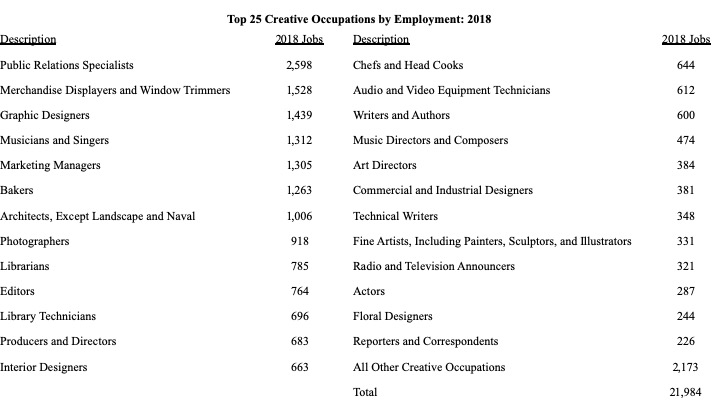
Lastly, we always take a brief look at the employment by creative occupation. The figures above are based on definitions by the NAICS industry codes, so the employment in the firms in these sectors includes all workers, regardless of whether or not they are engaged in creative work. However, the creative industry, or rather creative workers, play a somewhat unique role in the economy because they work in a variety of industries, including those that are defined as “creative.” Additionally, the firms in the creative industry support the growth of firms across all industries through the goods and services they provide. Looking at employment by creative occupation highlights these impacts in a very small way. This data indicate that there are 21,984 creative workers employed in all industries across the San Antonio economy.

Employment by Creative Occupation 2018

Summary of the Methodology

The geography used in the analysis was the San Antonio metropolitan statistical area. The employment and income data were provided by EMSI. This is the same data source that has been used in the previous studies of this industry, and it is used because it includes measures of the non-QCEW and self-employed workers. Self-employed artists are a key component of the creative industry who would not be captured by using the data from the Quarterly Census of Employment and Wages (QCEW).

The conversion factors used to calculate the overall economic impacts were calculated using the sales and payroll data by industry from the 2012 Economic Census. The data from the 2017 Economic Census were not yet available at the time the analysis was conducted, which made it necessary to use the 2012 data.

In order to calculate the multiplier effects, the export data for each sector of the creative industry was pulled from the EMSI database and run through the IMPLAN input-output model.

cropped-srn-logomark-gold-hires.jpg